Now we are engaged for some time, let's get connected

Digital transformation rarely fails of technology.
It fails because of structure.
Every year, thousands of businesses invest in Zoho CRM, Zoho Creator, Zoho Books, or the full Zoho One ecosystem expecting immediate clarity, automation, and operational control. However, months later, leadership teams often feel disappointed. Reports don’t match reality. Sales pipelines look inaccurate. Automation feels inconsistent. Departments operate in silos.
And the conclusion is almost always the same:
“Zoho isn’t working for us.”
But in most cases, the software is not the problem.
The absence of operational architecture is.
At Club Code Technology, now a Global Zoho Premium Partner, we have restructured and rebuilt numerous Zoho ecosystems across manufacturing, logistics, mobility, EV, healthcare, education, and enterprise sectors. The pattern is consistent. Most Zoho implementations fail because businesses configure before they clarify.
Let’s explore why that happens — and how to prevent it.
Zoho is one of the most flexible business ecosystems available today. It can manage lead generation, sales automation, production planning, accounting, inventory, HR workflows, service tickets, analytics, and AI-driven insights — all within one unified environment.
However, flexibility without planning creates risk.
When companies implement Zoho without mapping their real-world workflows, they unknowingly digitise existing inefficiencies. Instead of creating structured visibility, they replicate fragmented processes in a digital format.
Technology amplifies structure. If structure is unclear, chaos scales faster.
That is the root reason most Zoho implementations fail.
Successful implementation begins long before any module is activated.
Yet many organisations skip the most important step — defining their operational blueprint.
Before deploying Zoho, businesses must answer critical questions:
Without clearly documented answers, system configuration becomes guesswork.
We frequently encounter businesses where:
Sales teams update records inconsistently
Operations rely on spreadsheets
Finance uses separate accounting tools without integration
Reporting is compiled manually
Automation rules contradict each other
The system appears complex. In reality, the architecture was never defined.
There is a fundamental difference between implementing Zoho and architecting a scalable business system.
Configuration focuses on creating fields, pipelines, workflows, and dashboards.
Architecture focuses on designing:
How information flows across departments
How approvals are triggered
How performance is measured
How accountability is assigned
How the system will scale over five years
Most implementation failures happen because partners configure what is requested instead of questioning whether the request aligns with long-term business logic.
As a Global Zoho Premium Partner, Club Code Technology approaches implementation as operational engineering — not technical setup.
We begin with structured discovery workshops, stakeholder alignment sessions, workflow mapping exercises, and KPI definition before touching the platform.
Because once architecture is defined, configuration becomes clarity.
Another common reason Zoho implementations fail is partial adoption.
Many businesses deploy Zoho CRM but continue using disconnected tools for finance, inventory, HR, or service management. As a result, data duplication increases, reporting becomes unreliable, and decision-making slows down.
Zoho One is designed as an integrated ecosystem. However, integration does not happen automatically. It must be intentionally architected.
When CRM, finance, operations, and analytics communicate seamlessly, leadership gains real-time visibility. When they do not, digital transformation becomes an illusion.
Fragmentation is expensive — not only financially, but strategically.
Even technically well-designed systems fail without proper data governance.
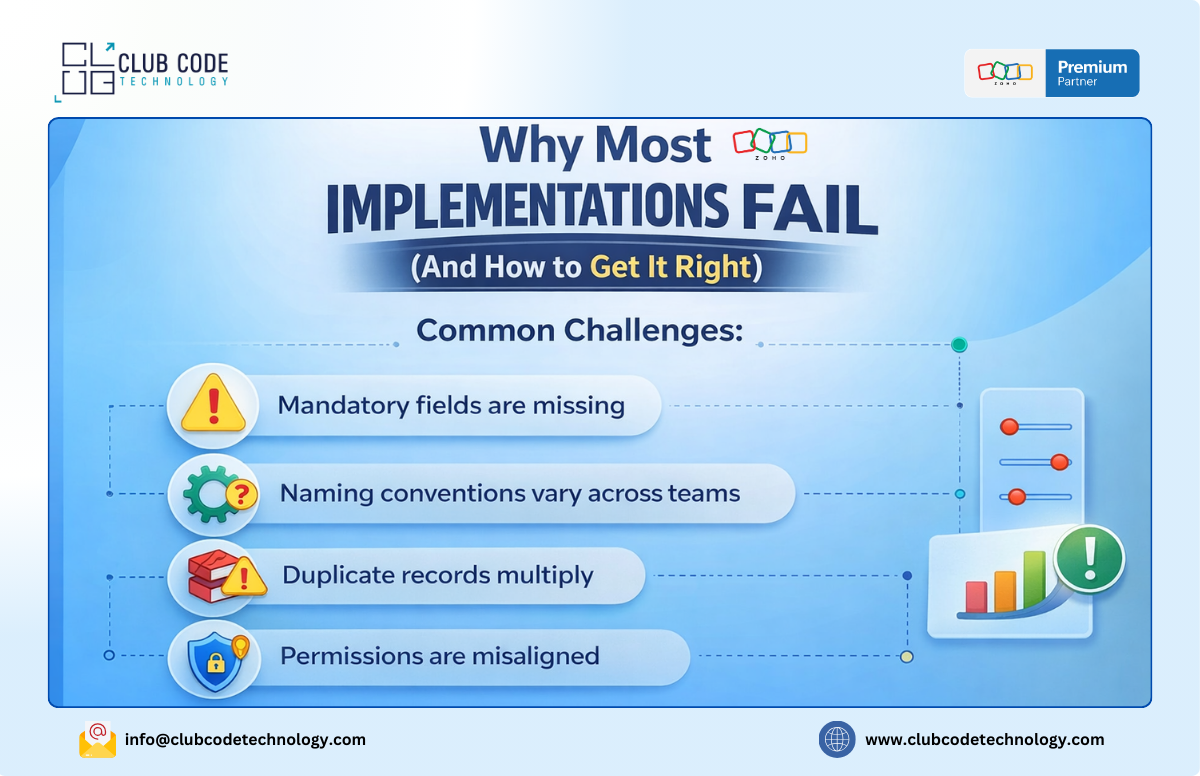
We often audit Zoho setups where:
Mandatory fields are missing
Naming conventions vary across teams
Duplicate records multiply
Permissions are misaligned
Reporting metrics are inconsistent
Over time, unreliable data erodes trust in the system. Once leadership stops trusting dashboards, they revert to spreadsheets. That marks the beginning of digital regression.
Data governance must be established at the start. It includes validation rules, ownership definitions, access controls, audit tracking, and performance reporting standards.
Without governance, automation cannot deliver reliable insight.
Zoho implementation is not an IT initiative. It is a business transformation decision.
If leadership teams are not aligned on KPIs, ownership responsibilities, and workflow accountability, no system can create clarity.
Successful organisations treat Zoho deployment as a strategic initiative. They define measurable outcomes before implementation. They align departments before activation. They communicate change expectations clearly.
Technology follows leadership clarity.
Without it, adoption remains superficial.
One manufacturing client approached us after two years of using Zoho CRM and Creator without meaningful impact.
Sales data was incomplete. Production updates were manual. Finance reconciliation took days. Reporting meetings were reactive.
The problem was not capability. Zoho had the potential. The issue was architectural misalignment.
We conducted structured blueprint workshops across sales, operations, and finance. We redesigned workflow triggers, integrated inventory logic, implemented cost tracking automation, and built executive dashboards aligned to margin KPIs.
Within months, production delays reduced significantly. Reporting accuracy improved. Leadership meetings shifted from firefighting to forward planning.
The software did not change.
The structure did.
Zoho’s flexibility requires architectural discipline. Without experience, it is easy to overconfigure, duplicate workflows, or build short-term solutions that require future rework.
As a Global Zoho Premium Partner, Club Code Technology operates with global delivery standards, governance frameworks, structured implementation methodology, and long-term scalability planning.
We are trusted to design systems that scale with growth, compliance requirements, and cross-border operations.
Implementation is not about activating modules.
It is about building an operational backbone.
Zoho implementations typically fail due to lack of process mapping, unclear ownership structures, poor integration planning, weak data governance, and absence of leadership alignment. The software itself rarely lacks capability; architectural planning is usually the missing component.
Zoho is flexible rather than difficult. Its flexibility requires structured planning. Without workflow clarity and integration design, complexity increases. With proper architecture, Zoho implementation becomes highly scalable and efficient.
Timelines vary depending on complexity. Small CRM implementations may take a few weeks, while full ERP-style deployments across departments may take several months. However, time invested in blueprinting significantly reduces long-term rework.
A Global Zoho Premium Partner brings certified expertise, structured methodology, cross-industry experience, governance standards, and architectural discipline. Instead of simple configuration, premium partners design integrated operational systems aligned with long-term business strategy.
When businesses say their Zoho implementation failed, they are often describing an architectural gap — not a technological one.
Zoho is a framework.
Its power depends entirely on how well it is aligned with business logic.
If your system feels underutilised, disconnected, or overly complex, the solution is not to replace the platform. It is to revisit the blueprint.
Digital transformation begins with clarity.
Automation succeeds when structure leads.
And scalable growth requires operational architecture.
If you’re ready to automate your operations Zoho One is your best investment—and Club Code Technology is your technology partner.
Sign up Zoho One Now For 1 MONTH FREE WITH ENTERPRISE FEATURES!

