Now we are engaged for some time, let's get connected

Every growing business eventually reaches a point where growth itself starts creating friction.
Not failure. Not chaos.
Just… resistance.
Finance teams begin taking longer to close the books. Operations rely on manual checks that didn’t exist earlier. Leadership meetings slowly shift from planning the future to reconciling numbers from different systems. The business is still moving forward — but it feels heavier than before.
This is usually the moment when ERP enters the conversation. And recently, with the launch of Zoho ERP, that conversation has become louder.
This guide explains how Zoho ERP for growing businesses works, who it’s designed for, and when adopting ERP makes sense
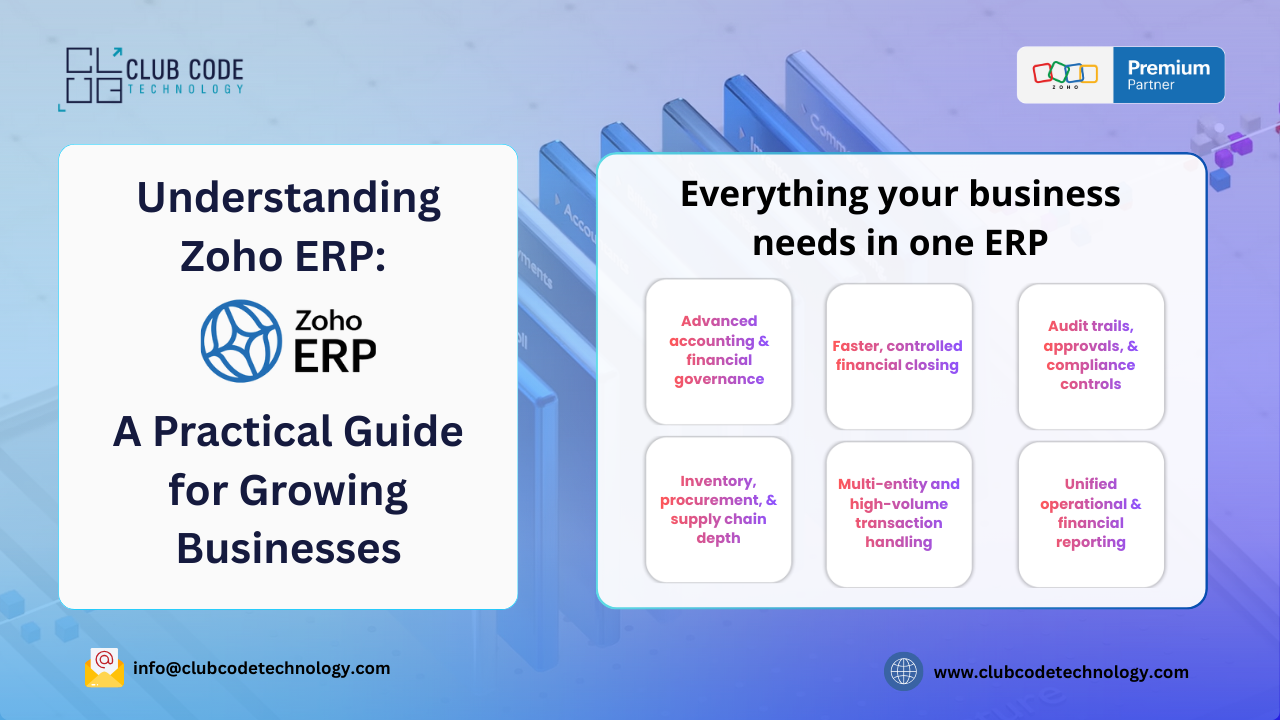
At Club Code Technology, a Global Zoho Premium Partner, we work closely with businesses navigating this exact phase. This article is not written to push ERP. It’s written to help you recognise why Zoho ERP exists, who it’s actually built for, and when adopting it makes sense — and when it doesn’t.
To understand Zoho ERP, you have to understand how businesses evolve.
In the early stages, speed matters more than structure. Decisions are quick, roles overlap, and flexibility is an advantage. Tools are chosen to help teams move faster, not necessarily to enforce discipline. At this stage, systems like Zoho One work beautifully — they unify teams without slowing them down.
But growth changes the rules.
As organisations mature, the cost of mistakes increases. A delayed financial close affects cash planning. Inventory misalignment impacts margins. Compliance can no longer be postponed. Leadership needs confidence that the numbers they see actually reflect reality.
This is where Zoho saw a clear gap.
Zoho ERP was not launched because Zoho One was lacking. It was launched because some businesses outgrow flexibility and need control. ERP is not about running faster — it’s about running predictably.
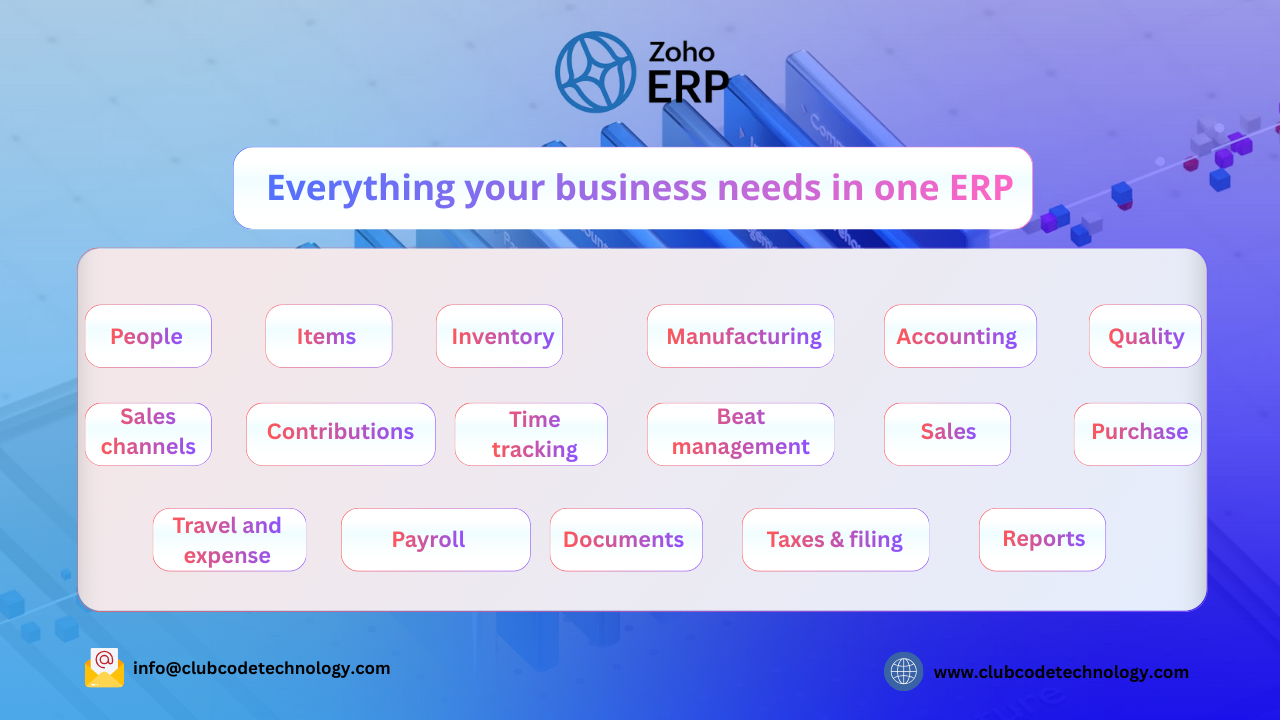
Zoho ERP is not a collection of apps stitched together. It is a system designed around one central idea: financial truth must sit at the heart of operations.
In many growing businesses, finance, inventory, procurement, and operations technically exist in the same ecosystem — but practically operate in silos. Numbers are correct individually, yet inconsistent collectively. Zoho ERP addresses this by creating a single operational backbone where transactions, approvals, compliance, and reporting are governed by structure rather than manual effort.
This is why Zoho ERP resonates strongly with businesses that are finance-led, operations-heavy, or compliance-driven. It doesn’t just show you what happened. It helps ensure things happen the right way.
Very few founders wake up thinking, “We need an ERP.”
Instead, the signals appear quietly.
Month-end closing starts feeling stressful instead of routine. Teams double-check reports because confidence is low. Inventory decisions begin affecting cash flow more visibly. Audits take more preparation than expected. Leadership spends more time validating data than acting on it.
This is not a tooling problem — it’s a maturity problem.
Zoho ERP is built for businesses that have crossed the stage of figuring things out and entered the stage of governing complexity.
Zoho ERP is not defined by company size. It is defined by operational weight.
It makes sense for businesses where operations are tightly linked to finance — manufacturing units, distributors, wholesalers, logistics-driven companies, and organisations managing multi-location or multi-entity structures. These businesses don’t just need software that works; they need systems that reduce risk, enforce discipline, and provide leadership with confidence.
In such environments, flexibility without control becomes a liability. ERP introduces structure — not to slow the business down, but to keep it stable as it scales.
This is where clarity matters.
Zoho ERP is powerful — but power assumes readiness.
Most small businesses are still discovering how their processes work. Decisions are informal, roles overlap, and adaptability is key. Introducing ERP too early can feel like wearing a suit of armour before you’ve learned to walk — protective, but restrictive.
ERP systems assume defined workflows, clear ownership, approval hierarchies, and financial discipline. Without these, ERP doesn’t fail — it simply underdelivers. This is why Zoho ERP is not positioned as a starting point. It’s designed as a next phase, not a first step.
One of the biggest misconceptions is that Zoho ERP and Zoho One compete with each other.
They don’t.
Zoho One is designed to help businesses run, collaborate, and grow across teams. Zoho ERP is designed to help businesses control, govern, and scale operations once complexity sets in.
In fact, many successful organisations follow a natural journey: they start with Zoho One, build operational maturity, and transition to Zoho ERP when structure becomes essential. This progression is intentional — and often the most sustainable approach.
Zoho ERP is not priced higher because it offers more apps. It’s priced higher because it reduces financial risk.
ERP systems invest in accuracy, compliance, audit readiness, and operational predictability. They protect businesses from the hidden costs of errors, delays, and misalignment. ERP is not a productivity expense — it’s a stability investment.
At Club Code Technology – Global Zoho Premium Partner, we don’t believe ERP should be implemented because it sounds impressive.
We believe it should be implemented when it becomes necessary.
Our role is to help businesses recognise readiness, not rush adoption. Sometimes the right answer is Zoho ERP. Sometimes it’s Zoho One. And sometimes, it’s waiting until processes mature further. That honesty is what ensures long-term success.
Is Zoho ERP suitable for startups?
Generally no. Startups benefit more from flexibility and speed, which Zoho One provides.
Can businesses move from Zoho One to Zoho ERP later?
Yes. This is a common and recommended progression as operational complexity grows.
Does Zoho ERP replace Zoho One?
No. They serve different stages of business maturity.
Is Zoho ERP only for very large enterprises?
Not necessarily large, but definitely process-mature and operations-heavy organisations.
Which industries benefit the most from Zoho ERP?
Manufacturing, distribution, wholesale, logistics, and finance-intensive sectors.
Zoho ERP is not about ambition.
It’s about readiness.
If your business still needs freedom to experiment, Zoho One is often the better foundation. If your business understands itself and now needs control, Zoho ERP becomes the right conversation.
📩 Lets talk to evaluate readiness honestly — and build a system that supports growth without slowing it down. Lets get ready for Zoho ERP 🙂

